
This post details how to connect to on-premises Active Directory and manage AD user objects—including creation and modification—using an Azure Automation Hybrid Runbook Worker.
Specifically, the workflow leverages PowerShell’s "Invoke-Command” to target an on-premises Domain Controller to execute changes. Credentials required for “Invoke-Command" can be dynamically retrieved using either Azure Automation Credential Assets or Azure Key Vault.
To execute these operations under least-privilege access, the script can run using either a dedicated service account or a computer account. Necessary permissions for Active Directory lifecycle management can be granted and delegated using either the “dsacls.exe” command-line utility or the Active Directory Delegation of Control Wizard GUI.
1. Service account (recommended)
✅ Why it’s the standard
• Designed for automation (scripts, apps, provisioning tools)
• Supports least-privilege delegation (e.g., only create users in one OU)
• Auditable → actions clearly tied to a named identity
• Not tied to a single machine

2. Computer account (not recommended)
A computer account (DOMAIN\SERVER01$) can create users if you delegate permissions, but it introduces problems:
❌ Drawbacks
• Tied to one machine (bad for scaling / failover)
• Harder to audit (was it the system or a process?)
• Password rotates automatically → can break integrations
• Blurs line between machine identity vs application identity
Azure Automation Account credential assets
From Azure automation account > Runbook > shared resources >
To add username and password as a shared resource under credential asset, select credentials and input the details.
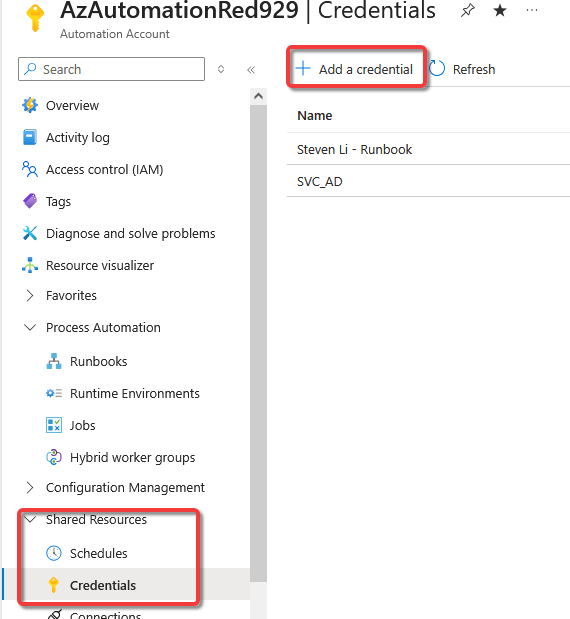
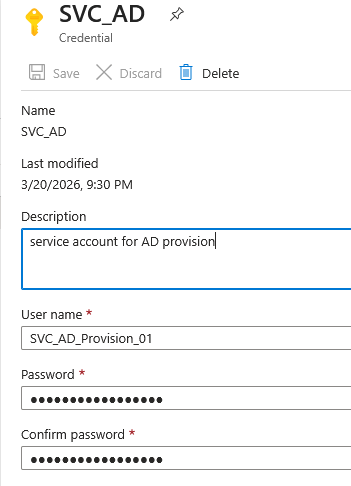
Add [SVC_AD_Provision01] service account that was created earlier. If called using “Get-AutomationPSCredential -Name ‘SVC_AD’“, the credentials are converted to PScredential object.

Example:
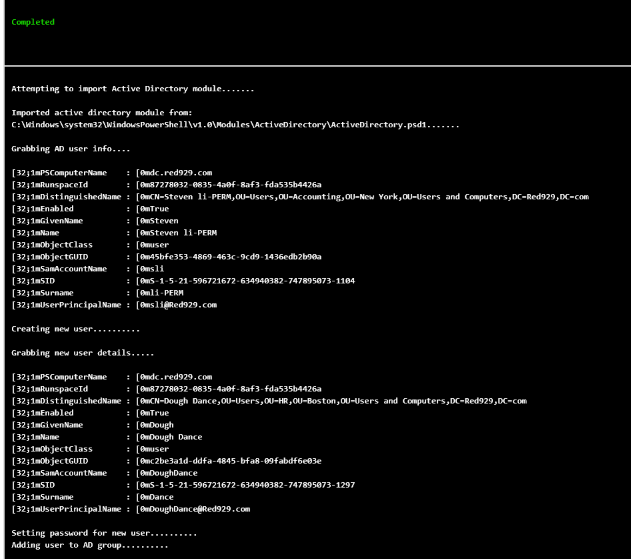
The following script invoke DC with [Svc_AD_Provision_01] credentials to do the following:

*Load AD module if necessary
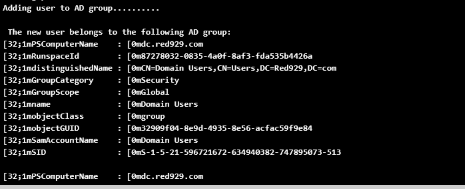
*Create new AD users and modify group membership.
*Set password
*Get AD user info
*Authenticate to DC using credential asset from Azure automation account
<# Goal: Connect to AD to create and modify AD user information for Hybrid worker runbook--------------------------Env: Hybrid worker runbookRun As: NT AUTHORITY\SYSTEM$Credential: SVC_AD_Provision_01 (To access network resources)--------------------------Credentials is configured under shared resource in the automation account blade. AD service account creds can be passed on via $Credential#>######################## Install AD Module ######################### Get the credential asset$credential = Get-AutomationPSCredential -Name 'SVC_AD'Invoke-Command -ComputerName dc.red929.com -ScriptBlock {# Check if AD module is loaded - $AD_Module = get-module -Name activedirectory # If module is not loaded - try import it if(-not $AD_Module){ Write-Output "Attempting to import Active Directory module.......`n" import-module activedirectory -Force # Check module post import $AD_Module_Check = get-module -Name activedirectory # Module path $Path = (Get-Module -ListAvailable activedirectory).path if(Test-Path -path $Path){ Write-Output "Imported active directory module from:`n$path.......`n" } # If importing module fails - install it then import it if(-not $AD_Module_Check){ # Install the windows feature Write-Output "##### Installing RSAT AD and import AD module #####`n" Install-WindowsFeature -Name “RSAT-AD-PowerShell” -IncludeAllSubFeature #For Windows Server # Import the module Write-Output "`nImporting Active Directory module.......`n" import-module activedirectory -Force # Check for imported module if(get-module -Name activedirectory){ Write-Warning "`n##### Actived directory module is installed and imported successfully #####`n" # Module path $Path = (Get-Module -ListAvailable activedirectory).path Write-Output "`nImported Active Directory module from:`n$path.......`n" }else{ Write-Warning "`n##### Active Directory module is NOT installed #####`n" } } }# Get AD infoWrite-Output "Grabbing AD user info...."Get-ADUser -Identity sli# Create a new userWrite-Output "Creating new user.........."$firstName = "Dough"$lastName = "Dance"$accountName = "DoughDance"$dnsroot = '@' + (Get-ADDomain).dnsroot$OU = "OU=Users,OU=HR,OU=Boston,OU=Users and Computers,DC=Red929,DC=com"$password = "lazyPass123" $userDetails = @{ GivenName = $firstName Surname = $lastName Name = "$firstName $lastName" SamAccountName = $accountName UserPrincipalName = $accountName + $dnsroot Path = $OU AccountPassword = (ConvertTo-SecureString -AsPlainText $password -Force) Enabled = $true ChangePasswordAtLogon = $true}New-ADUser @userDetails Write-Output "`nGrabbing new user details.....`n"Get-ADUser -Identity $accountName # Set password for the userWrite-Output "Setting password for new user.........."Set-ADAccountPassword -Identity $accountName -Reset -NewPassword (ConvertTo-SecureString -AsPlainText "Shell@@1" -Force) # Add user to a groupWrite-Output "Adding user to AD group.........."Add-ADGroupMember -Identity "Test_group" -Members $accountNameWrite-Output "`n The new user belongs to the following AD group:"Get-ADPrincipalGroupMembership -Identity "$accountName"} -Credential $credential
 Steven’s Knowledge Base